
Marlborough and the Abel Tasman: A 10-Day Itinerary

One March, while we were living in New Zealand, we had the pleasure of hosting Dawn’s parents for their second visit to the country. When we asked Dawn’s mum where she wanted to go back to, before Dawn could even finish the question, the answer came back: “the Abel Tasman.” It wasn’t hard to talk us into it. There’s something about those white sand beaches that makes you feel like you’ve landed in paradise, so back to paradise we went.
This time, rather than covering the length of the South Island like our 10-day South Island self-drive itinerary, we slowed right down and focused on two regions at the top of the South Island: Marlborough and the Abel Tasman. This is the 10-day Marlborough and Abel Tasman itinerary we travelled from Wellington, and it’s still the route we’d send friends on if they only had this corner of the South Island to explore.
In this article
- The route: Marlborough Sounds to the Abel Tasman
- Day by day, from the ferry crossing to the vineyards
- What we’d do differently
- Booking and budgeting tips
- Your questions answered
Prices below are in New Zealand dollars (NZD). As we wrote this in July 2026, roughly NZ$2.33 bought one pound sterling and NZ$1.72 bought one US dollar, though exchange rates move, so check a live converter before you travel. Where a price has likely changed since our trip, we’ve said so and pointed you to book online instead.
The route
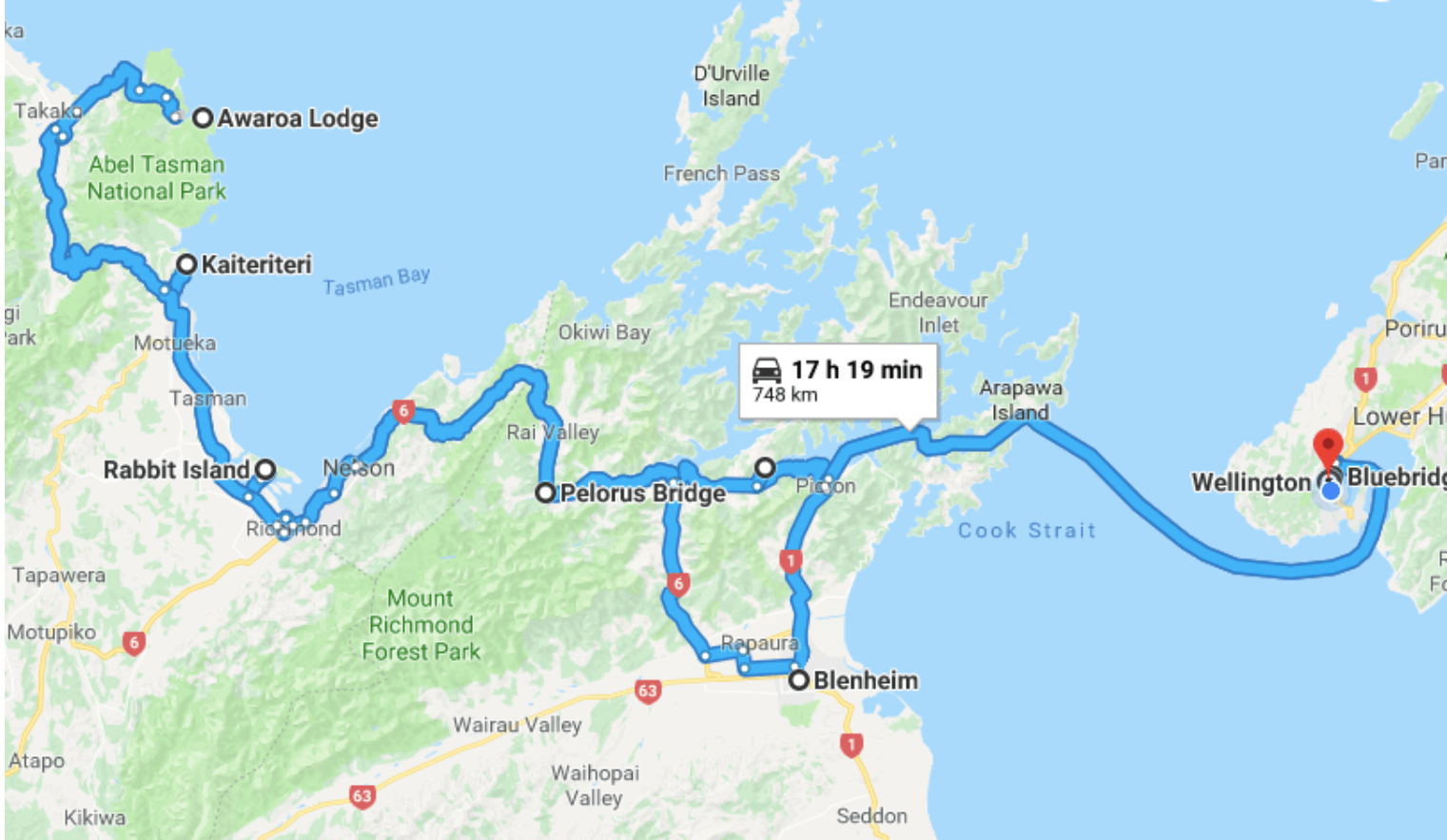
Highlights of this itinerary
- The Queen Charlotte Track, on foot and by bike
- Pelorus Bridge
- Havelock
- A day at Rabbit Island (Moturoa)
- Several days of adventure in Abel Tasman National Park
- An overnight stay at Awaroa Lodge
- Wine tasting at Blenheim’s top vineyards
This wasn’t a sponsored trip. We travelled with family, and everything here is based on what we actually did and saw.
Want to see more of the South Island? Our 10-day South Island self-drive itinerary covers the length of it, and our full Abel Tasman National Park travel guide goes much deeper into the park itself, including tides, the coast track and where to stay.
Day by day
Day 1: Ferry to Picton
We took a mid-morning Bluebridge ferry from Wellington to Picton with our car (you can also hire a car from Picton if you’d rather not bring your own, and Interislander runs the same route too). The crossing itself was calm and pleasant. We kept ourselves busy photographing the Wellington coastline on the way out and the Marlborough Sounds as we arrived, and enjoyed the coffee and the TV room on board.
It’s worth allowing more time than you’d think. Our sailing left late and arrived later, so a crossing that should take around 3 to 3.5 hours turned into five. Loading and unloading all the cars, cargo and lorries takes a while and tests your patience. We were glad our accommodation was only 25 minutes outside Picton, in a small settlement called Anakiwa.
As travel days go, this is a long one, so don’t underestimate how much extra time the crossing can add, especially in poor weather.
Top tip: if you can travel as a foot passenger, do. Foot passengers board first, get the best seats, and get off first too, much quicker all round. Book your crossing online in advance and check the current fare and schedule before you travel, both change through the year.

Goodbye Wellington.
Day 2: Discovering Anakiwa and the Marlborough Sounds
With rain forecast, this looked like our only real window to explore the Queen Charlotte Track. So instead of the leisurely bacon-and-eggs morning we’d been picturing, we were on the track by 10am, walking to Davies Bay.
Our Airbnb came with kayaks and mountain bikes we could use. Isaac cycled a section of the track (easily done in the drier summer months) and got further than the rest of us, while we walked as far as Davies Bay, a two-hour return walk, and had a picnic lunch at a much more leisurely pace.
The heavens opened late in the afternoon, and our plans to kayak the bays vanished with them.
Top tip: Anakiwa is a great base for walkers wanting to do sections of the track, since a water taxi runs daily to various points along it. It’s also considerably cheaper than staying in Picton itself.

Rainy day at Anakiwa.
Day 3: Pelorus Sounds and Kenepuru Sounds
The weather put a real dampener on our plans to cruise and walk more of the Sounds, so we swapped to driving the scenic Queen Charlotte Drive and Kenepuru Sounds instead, stopping often for photos. It’s a genuinely good wet-weather alternative if you find yourself in the same spot.
For dinner, we drove the 25 minutes to Havelock and ate at The Captain’s Daughter, a craft beer bar and bistro we can happily recommend. It has a cosy, friendly atmosphere, which was very welcome on a wet and windy evening.
Day 4: Travel to Motueka (around 2 hours 15 minutes)
Our second travelling day of the trip. Having already seen Havelock the day before in the rain, our pit stop today was Pelorus Bridge and its café, a spot we’d first visited back in 2010 on an epic six-month road trip around New Zealand. It hadn’t changed much.
We did the short 45-minute loop walk through the bush and along the river, then grabbed a quick coffee at the café before getting back on the road.
We’d forgotten how good the drive into Nelson is. As soon as you crest the hill and drop down towards Nelson, the highway more or less follows the sea the whole way round the bay. It’s a proper coastline.
Our lunch stop was Jester House, just off the highway on Aporo Road as you approach Motueka. Friends had told us to allow at least two hours; we stayed for three. Jester House is a genuine Kiwi gem: a café set in beautifully presented gardens they’ve grown themselves for over two decades, with a real love of food that comes through on the menu.
Worth knowing before you plan around it: Jester House has changed a lot since our visit. It’s no longer open daily; as of 2026 it trades Fridays only (roughly 10am to 5pm, closed on public holidays, plus a summer break over Christmas and New Year). If your route doesn’t land on a Friday, treat it as a “if the timing works” stop rather than a guaranteed lunch spot, and check their current hours before you build a day around it.
It’s family-friendly too, with a treehouse (yes, I climbed it), a slide, a play area and a spot where you can feed the resident eels. Hours of fun, Friday permitting.

Beautiful Pelorus Bridge.
Day 5: A day exploring Rabbit Island
Knowing we had plenty of Abel Tasman time ahead, we used this day to explore a bit more of the Nelson coastline instead. Rabbit Island (Moturoa) is a small island just 20 minutes from Nelson, connected to the mainland by a bridge that cars can cross easily to reach the beach and its forested woodland.
We had a lovely day at the beach (the sun was finally out), swimming, walking the long circular tracks through the woods, and having a picnic. The access bridge closes at sunset and there’s no overnight camping on the island, so plan your visit as a day trip.
Top tip: if you want to dodge the tourist trail, Rabbit Island is the place. The visitors here are almost entirely locals (who else turns up with a bus and camps out for the day?), so it’s a genuinely relaxed, low-key day.

Beach day at Rabbit Island.
Day 6: Kaiteriteri, beach sunbathing
The weather had well and truly turned by now, and we were fully in holiday mode, soaking up every minute of it. We planned a day of beach sunbathing at Kaiteriteri, not realising we’d picked the day of the local fun run: the beach was packed.
We shifted over to Little Kaiteriteri, a lot quieter, and spent the afternoon at Sprig + Fern, Motueka’s craft beer taproom. A beer in the afternoon sun is hard to argue with.

View of Kaiteriteri.
Day 7: Awaroa Lodge
This was the day we’d all been looking forward to most, and we were hoping the good weather would hold. It did.
We took the 9am Abel Tasman Sea Shuttles ferry to Awaroa Inlet from Kaiteriteri (still the main operator running this route). We got everyone there for 8.30am to check in, and were glad we did: at 8.30 there was no queue, but within ten minutes it stretched around the block. Abel Tasman’s popularity has clearly kept climbing.
The commentary on the way up the coast was genuinely good. We saw Split Apple Rock and felt like we’d had a proper tour of the coastline, not just a transfer.
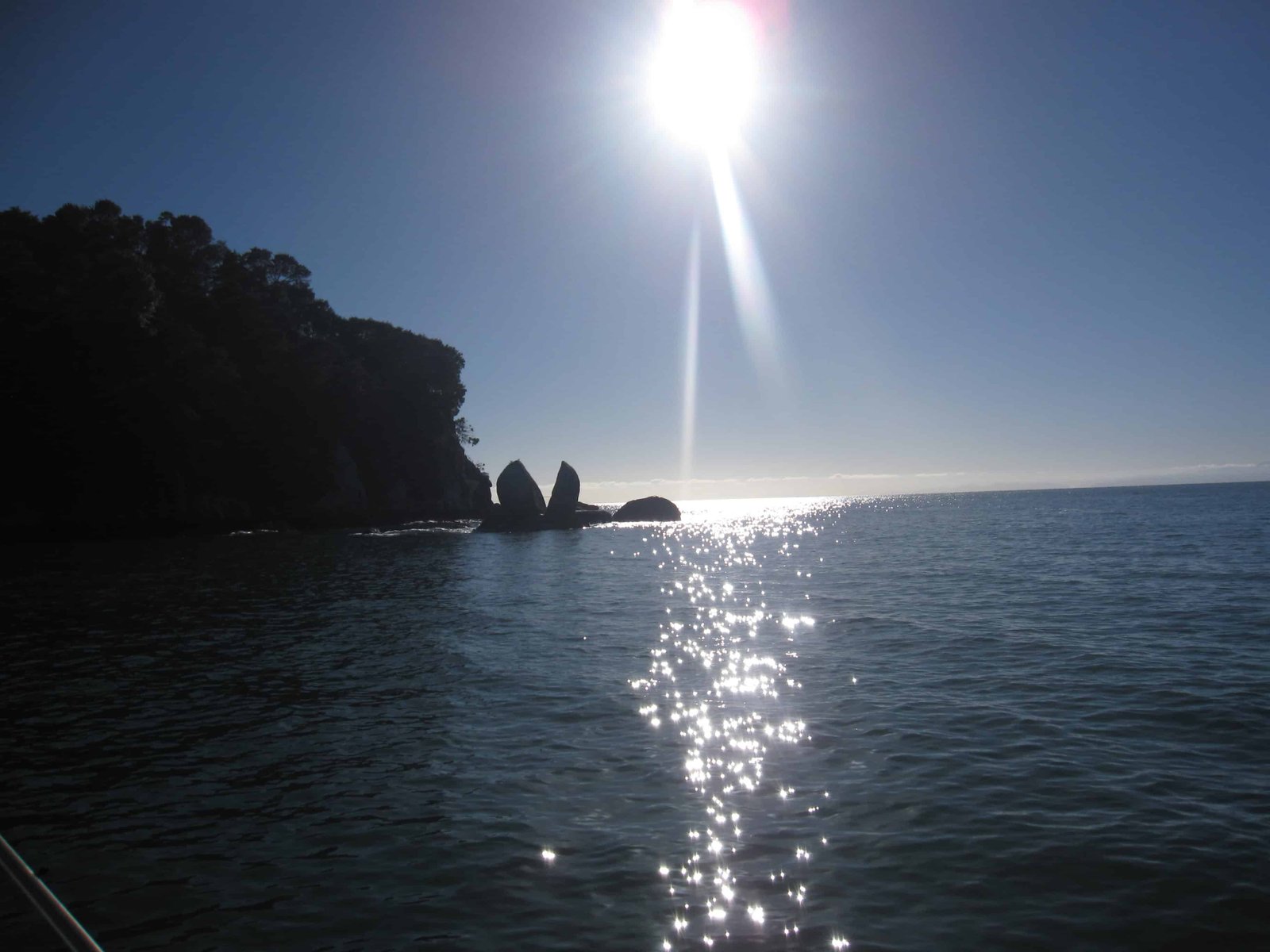
Split Apple Rock.
Our accommodation for the night was Awaroa Lodge, a four-star lodge in the bush a short walk from the beach. Or it would have been short: storm damage to the wooden platform a few weeks before our visit meant the walk was a longer 20 minutes instead of five, though at least it was flat and sheltered. Awaroa Lodge operates seasonally (broadly September or October through to April), so check current opening dates before you plan a trip around it.
We spent the morning exploring Awaroa Inlet before the tide came in and cut us off, and the afternoon climbing to the viewpoint and walking a section of the Great Walk. The views over the inlet were superb, and we found a slightly sketchy rope swing that, of course, we had to try.
Awaroa Lodge has two dining options: the outdoor pizzeria or the in-house restaurant. With the evenings cooling off, we chose the restaurant, and despite having no intention of eating a three-course meal, we absolutely did.
We finished the evening with a glow worm spotting walk through the wetlands. Clear sky, still air, one of those nights you don’t forget.
Top tip: if you can manage an overnight stay in Abel Tasman National Park, do it. Once the day trippers leave, you get the park to yourself, and that’s the park at its best.
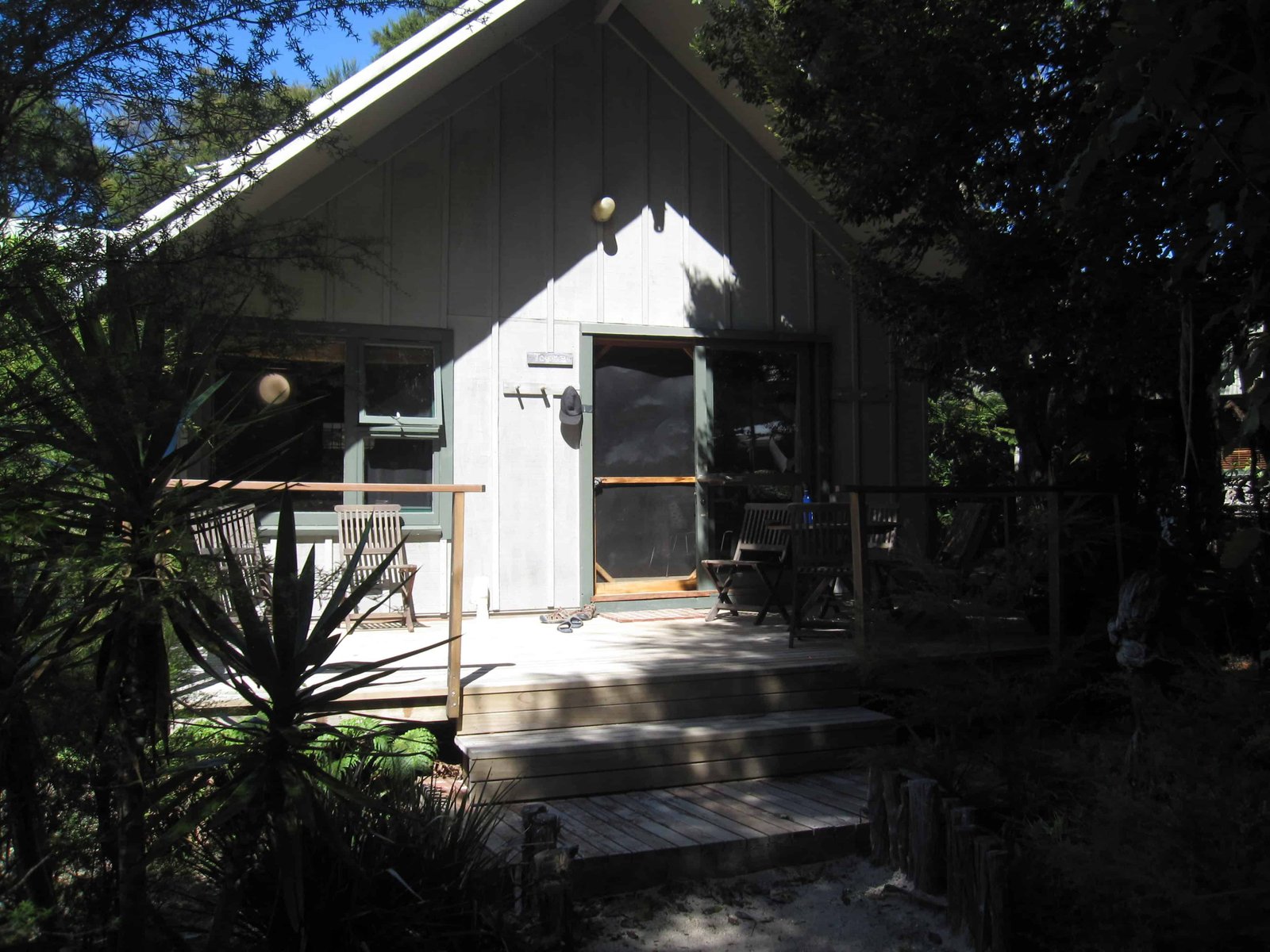
Chalet at Awaroa Lodge.
Day 8: Leaving paradise, travel to Blenheim (around 2 hours 45 minutes)
Time to head back to civilisation. We stayed in Blenheim for two nights, mainly to break up the return journey to Wellington.
Breakfast at Awaroa Lodge was a proper full English, then we made our own way back to the beach to wait for the ferry, which was running late. We didn’t mind too much; the sun was out and the beach is beautiful. We picked up our car, which we’d left safely at Kaiteriteri overnight, and didn’t reach Blenheim until after 4pm. If you’re planning this route, bear in mind that ferry departures from Abel Tasman generally run later in the day, since the priority is getting day trippers out into the park first; overnight guests get picked up on the way back.
Top tip: if you’re doing an overnight trip into Abel Tasman, consider staying in Nelson the following night rather than pushing on to Blenheim. The drive, with scenic stops, took longer than we expected.

Bye bye Abel Tasman.
Day 9: Wine o’clock, Blenheim
Our day to explore Marlborough’s internationally renowned vineyards. We had our designated driver sorted (Dawn’s dad, who drew the short straw) and summer outfits at the ready for a self-guided tour of the region.
Brancott Estate was our first stop, chosen partly because we wanted to try something beyond the obvious big name, though you really can’t argue with their location or their place in the industry. The tasting itself, and the attention we got, was excellent. Several tasting tiers are usually on offer; check current pricing on arrival or online, as this changes often.
Top tip: get there early. The place fills up quickly through the morning.
Our second stop was Highfield Estate, now trading as Highfield TerraVin, worth visiting for the chateau-style building alone. Service was a little less attentive than at Brancott, though the wines were still worth tasting.
Our third stop and lunch spot was Wither Hills, on the main road but tucked behind a beautifully landscaped, enclosed courtyard you’d never guess was there from the street. This tasting was done seated at a table, which felt less rushed, and our host talked us through where each wine’s grapes were grown. Afterwards we moved into the restaurant for a large sharing platter and, naturally, another bottle of wine. A proper long lunch, and a fitting end to the day.
If you’d rather not worry about a designated driver, Bubbly Grape Wine Tours run guided tours around the region and are still operating today.

Wine tasting in Blenheim.
Day 10: Return to Wellington
Time to leave the South Island for another year. We loaded the car with all the wine we’d bought the day before and caught the early Bluebridge ferry back to Wellington. This time it ran on schedule, and we were home by 1pm, right in time for lunch.
So there you have it, the top of the South Island in 10 days. Looking back, here’s what we’d change:
- Stay in Kaiteriteri instead of Motueka (nicer, and more to do on foot)
- Add an extra night in Nelson after Abel Tasman
- Never underestimate how long it takes to get from A to B up here
- Eat at Jester House more than once, Friday hours permitting
- Visit Golden Bay, which was on the original plan but the access road was closed for storm repairs when we went. It’s still on our list, and if you have a spare day, it’s a genuinely worthwhile detour from Motueka over Tākaka Hill.
Booking and budgeting tips
New Zealand gets properly busy between September and March, so book accommodation well ahead if you’re travelling then. Bookabach is worth checking for private holiday homes you won’t find on other platforms, and our South Island accommodation options link has live availability for motels, hotels and guesthouses in the region. If you want to make the trip stretch further, our guide to travelling New Zealand on a budget has practical ways to cut costs without cutting the itinerary short.
Visiting the North Island too? Check out our 10-day North Island self-drive itinerary.
Your questions answered
How long does the Wellington to Picton ferry take, and should I book ahead? Both Interislander and Bluebridge advertise a crossing of roughly 3 to 3.5 hours, though loading, weather and Cook Strait conditions can add time, ours once turned into five hours. Book online ahead of time, especially in summer, and build in slack either side rather than booking a tight connection.
Is Jester House Café still open every day? No, and this is the biggest change since our trip. Jester House now trades Fridays only, roughly 10am to 5pm, with a summer break over Christmas and New Year. Check their current hours before you plan a stop, and have a backup lunch option in mind for the rest of the week.
Do I need to book Awaroa Lodge and the Abel Tasman Sea Shuttles ferry in advance? Yes, especially in peak season. Awaroa Lodge is seasonal and popular, and the ferries fill up fast, we watched the queue for our own sailing go from empty to around the block in under ten minutes. Book both well ahead if your dates are fixed.
Can you still visit Golden Bay on a trip like this? Yes. We missed it on this particular trip because the access road over Tākaka Hill was closed for storm repairs, but the road is a normal, sealed route in typical conditions. If you have an extra day, Golden Bay (Pōhara, Wainui and the walk to Wharariki Beach) is a genuinely worthwhile add-on from Motueka.
What’s the best time of year for the Marlborough and Abel Tasman region? Summer (December to March) gives you the best odds of good weather for kayaking, beach days and the Sounds, and it’s also harvest and wine-tasting season in Marlborough. It’s the busiest and priciest time too, so book well ahead if you’re travelling then.
Do I need a 4WD for this itinerary? No. Every road on this route, including the Queen Charlotte Drive and the road to Rabbit Island, is sealed and manageable in a standard hire car. A car is not useful once you’re inside Abel Tasman National Park itself; you travel by boat and on foot there instead.
Got a question about this route we haven’t covered? Get in touch with us here.
You might also like
Aoraki / Mount Cook Travel Guide
Our real Aoraki / Mount Cook guide: Hooker Valley Track status, Tasman Glacier, Dark Sky stargazing and where to stay. Updated August 2026.
A Weekend on the Coromandel Peninsula
Our updated 2026 guide to a weekend on the Coromandel Peninsula: Cathedral Cove's current access, Hot Water Beach timing, road status and where to stay.
The New Zealand bucket list: experiences that are actually worth it
Our honest New Zealand bucket list: 11 experiences from ten years living there, with genuine opinions on what's worth it and what to skip. Updated 2026.