
Cost of Living in New Zealand: Our Real Costs, 2015 to 2026

We spent ten years in New Zealand and kept a close eye on what it all cost, from the rent to the price of apples. Here is the honest picture: the current 2026 numbers first, then our own bills year by year, and the handful of tools we used to work it out. Everything is in New Zealand dollars unless we say otherwise.
In this article
- What it costs to live in New Zealand in 2026
- Our 2026 supermarket basket: NZ vs the UK, Australia and the USA
- Our monthly costs, 2015 to 2025
- How the weekly shop compares
- Working out your own numbers
- Is it worth it?
- Frequently asked questions
What it costs to live in New Zealand in 2026
Money is the thing people underestimate most, so let us be straight about it. In 2026 a couple generally needs around NZ$5,000 to $7,000 a month to live comfortably, depending on the city and how you live. Rent is the big one, and it is charged weekly here, which catches every newcomer out: a two-bedroom place runs about $680 a week in Auckland and closer to $470 a week in Hamilton. GST of 15% is baked into almost everything, groceries and power sting compared with the UK, and car insurance has climbed to around $1,311 a year for comprehensive cover. For a full pre-move budget, see how much money you need to emigrate to New Zealand.

Our 2026 supermarket basket: NZ vs the UK, Australia and the USA
Here is a like-for-like basket of six everyday items, priced in each country in July 2026. We used standard, own-brand or mainstream products of the same size where we could: Woolworths in New Zealand and Australia, Tesco in the UK, and Walmart in the US.
| Item | New Zealand | United Kingdom | Australia | United States |
|---|---|---|---|---|
| Milk, 2L | NZ$4.91 | £2.10 | A$3.55 | US$1.97 |
| Bananas, 1kg | NZ$3.75 | £0.90 | A$4.00 | US$1.10 |
| Gala apples, 1kg | NZ$4.95 | £2.80 | A$4.90 | US$2.38 |
| White loaf | NZ$4.30 | £1.25 | A$2.50 | US$1.63 |
| Eggs, dozen | NZ$8.50 | £3.30 | A$6.60 | US$1.47 |
| Butter, 500g | NZ$8.39 | £3.90 | A$7.00 | US$3.37 |
| Basket total (local) | NZ$34.80 | £14.25 | A$28.55 | US$11.92 |
| Same basket in NZ dollars | $34.80 | $33.00 | $34.26 | $20.40 |
Converted at the day’s rates (1 GBP = NZ$2.32, 1 AUD = NZ$1.20, 1 USD = NZ$1.71), the same trolley costs about NZ$34.80 in New Zealand, NZ$33.00 in the UK and NZ$34.26 in Australia, so those three are now neck and neck. The standout is the United States at roughly NZ$20, well under the rest, driven by cheap milk, bread and eggs. That gap surprises a lot of the Americans now looking at a move here.
Prices shift weekly and with location. US milk is sold by the gallon and butter by the pound, so we scaled those to 2 litres and 500g, the Australian banana price is estimated per kg from a per-each shelf price, and loaf sizes range from 650g to 800g. It is a snapshot, not gospel.
Our monthly costs, 2015 to 2025
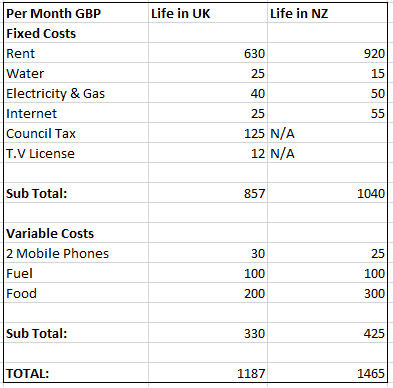
We tracked our own outgoings across the whole decade, from a flat in Auckland to a rural patch up in Northland. We noted them in pounds at the time to compare with our old life, and we have converted them back to New Zealand dollars here so they reflect roughly what we actually paid.
| Per month (NZD) | 2015 · Auckland | 2019 · Wellington | 2022 | 2025 · Northland |
|---|---|---|---|---|
| Rent | $1,645 | $2,120 | $2,020 | $2,365 |
| Water | $25 | $50 | $0 | $0 |
| Power (electric & gas) | $90 | $115 | $165 | $200 |
| Internet | $100 | $105 | $115 | $95 |
| Phones (two) | $45 | $50 | $50 | $55 |
| Fuel | $180 | $290 | $385 | $495 |
| Food | $535 | $670 | $770 | $860 |
| Total per month | ~$2,620 | ~$3,400 | ~$3,505 | ~$4,070 |
Converted at each year’s approximate exchange rate and rounded to the nearest few dollars.
Our costs climbed from about NZ$2,620 a month in 2015 to roughly NZ$4,070 in 2025, a rise of around 55% in a decade. Rent did most of the damage early on. Lately it is food and fuel doing the climbing: fuel because we moved somewhere far more rural, and food because prices have jumped noticeably since COVID. We grow a lot of our own vegetables and keep chickens for eggs, so our food bill would be higher still without the garden. Our water has been free for years too, since we are off the town supply and collect rainwater.
How the weekly shop compares
Back in 2015, a year into our life here, we ran a like-for-like grocery comparison against our old shop in Falmouth, Cornwall. We picked nine everyday items and totted them up.
| Item | England | New Zealand |
|---|---|---|
| Bananas | £0.28 | £0.60 |
| Apples | £1.55 | £1.15 |
| Tomatoes | £1.55 | £3.91 |
| Paracetamol | £0.30 | £1.50 |
| Facial wipes | £1.00 | £2.79 |
| Tin foil | £2.74 | £1.12 |
| Milk, 2L | £1.30 | £1.76 |
| Snack bars | £1.00 | £1.68 |
| Ready salted crisps | £1.00 | £0.78 |
| Total | £10.72 | £15.29 |
New Zealand came out about 42.6% dearer for that basket. The pattern was telling: imported bits like paracetamol and facial wipes stung the most, while fresh and seasonal produce often evened out or came in cheaper. A decade on, the gap has narrowed sharply. Our 2026 basket higher up shows New Zealand, the UK and Australia roughly level now, with the United States the clear outlier for a cheap shop.
Working out your own numbers
A few tools we leaned on, and still would:
- Numbeo to compare your current city with a New Zealand one on rent, transport and a typical shop.
- Powerswitch for power and broadband costs.
- AA PetrolWatch for current fuel prices.
- Seek or Trade Me Jobs for realistic local salaries, because you need to weigh new costs against a new wage, not your old one.
- A comparison site like Quashed for insurance quotes.
Whatever you tally up, remember GST of 15% sits on almost everything you buy.
Frequently asked questions
Is New Zealand expensive to live in?
Housing, groceries and power are the pinch points. Our basket puts New Zealand roughly level with the UK and Australia, and dearer than the US, and a couple generally needs NZ$5,000 to $7,000 a month.
Is the cost of living higher in New Zealand than the UK?
Back in 2015 our shop was about 42.6% dearer in New Zealand. By 2026 that gap has largely closed, as our four-country basket above shows.
What is the cheapest place to live in New Zealand?
The main centres, Auckland, Wellington and Queenstown, are the priciest for rent. Smaller cities and rural regions such as Hamilton or Northland are noticeably cheaper.
How much does a weekly food shop cost in New Zealand?
For a couple, expect somewhere around NZ$150 to $250 a week depending on how and where you shop. Farmers’ markets and local produce shops help take the edge off.
Is it worth it?
The lesson we learned over time was to stop analysing it quite so hard. Yes, New Zealand asks a lot of your wallet. But you are paying for the setting: the space, the outdoors, the slower pace of life. Once we stopped comparing every receipt to our old life in England, the maths mattered a lot less. When we weighed it all up, we reckoned it was worth the extra, and most of the people we know here feel the same. We dig into both sides in the pros and cons of living in New Zealand.
Thinking of making the move? Start with our guide to moving to New Zealand.
You might also like

Best Places to Live in New Zealand in 2026: Our Honest, City-by-City Guide
Auckland, Wellington, Christchurch and six more places compared on rent, jobs and climate for 2026, from a couple who actually lived in three of them.

The Best Banks in New Zealand for Migrants
Which New Zealand bank is best for migrants in 2026: ANZ, ASB, BNZ, Westpac, Kiwibank and the challengers compared, fees, apps and deposit protection.

Buying a Car in New Zealand: A 2026 Guide to Costs, WoF and Rego
Buying a car in New Zealand: 2026 prices for WoF, rego, insurance and RUC, plus where to buy, imports and EVs, from a couple who actually did it.