
Our Day Trip to Abel Tasman National Park
In this article:
- Choosing how to see the park in a day
- Our kayak (and walk) day from Awaroa to Bark Bay
- Split Apple Rock, if you have the time
- Track and tide conditions to check before you go
- Our top tips for a day trip
- Where to stay near the park
- Your questions answered
When we first visited New Zealand we did a South Island road trip and, for reasons that were probably more about budget than time, we skipped Abel Tasman National Park entirely. It is one of the few regrets from that whole trip. So when the chance came up years later to head south again with my parents, Abel Tasman went straight to the top of the list.
We had heard so much about the place: the idyllic beaches, how good the kayaking is, how everyone who goes seems to come back raving about it. So we booked a day out with Abel Tasman Kayaks, based in Mārahau, because we wanted to do something active and kayaking sounded like the obvious way in.
This is our own day trip, not a full planning guide. For tides, the whole coast track, accommodation and history, our Ultimate Abel Tasman National Park Travel Guide covers all of that in depth. This page is the shorter version: what a single day in the park actually looks like, and what we’d tell a friend planning the same thing.
Choosing how to see the park in a day
Mārahau is the southern gateway to the park and the base for most day-trip operators. Abel Tasman Kayaks run guided kayak tours, kayak-and-walk combos and kayak hire for confident paddlers. If you’d rather not paddle at all, Wilsons Abel Tasman run cruises and walking transfers from Kaiteriteri, and water taxis run up and down the coast all day dropping walkers at Anchorage, Bark Bay, Onetahuti and beyond.
Worth knowing for 2026: Marahau Water Taxis merged into Abel Tasman AquaTaxi in October 2025, so AquaTaxi is now the only water taxi company operating directly out of Mārahau. If a guidebook or old blog post (including our own, previously) mentions Marahau Water Taxis by that name, it is the same operation under a new banner.
We turned up at Abel Tasman Kayaks’ base and, in true GoingNZ style, put the wrong address into the GPS first and ended up parked outside a stranger’s house. The actual base is about 500 metres further up Sandy Bay Mārahau Road and, once we found it, it turned out to be a properly slick operation: toilets, coffee, picnic benches and a check-in queue that looked chaotic until you realised each little cluster of people was a different group heading out for the day. We got our safety briefing, then a tractor towed our water taxi down the boat ramp and out onto the water.
Our kayak (and walk) day from Awaroa to Bark Bay
We’d booked what was then called the “Remote Coast” trip: a water taxi up to Awaroa, then kayaking south via Shag Harbour and Onetahuti to finish at Bark Bay. Abel Tasman Kayaks still run this exact route today under the name Remote Marine Reserve, priced at around NZ$410 per person as of July 2026 (roughly £175 or US$235 at current rates, though exchange rates move, so check the conversion before you book). It includes lunch and runs from around 8.15am to mid afternoon.
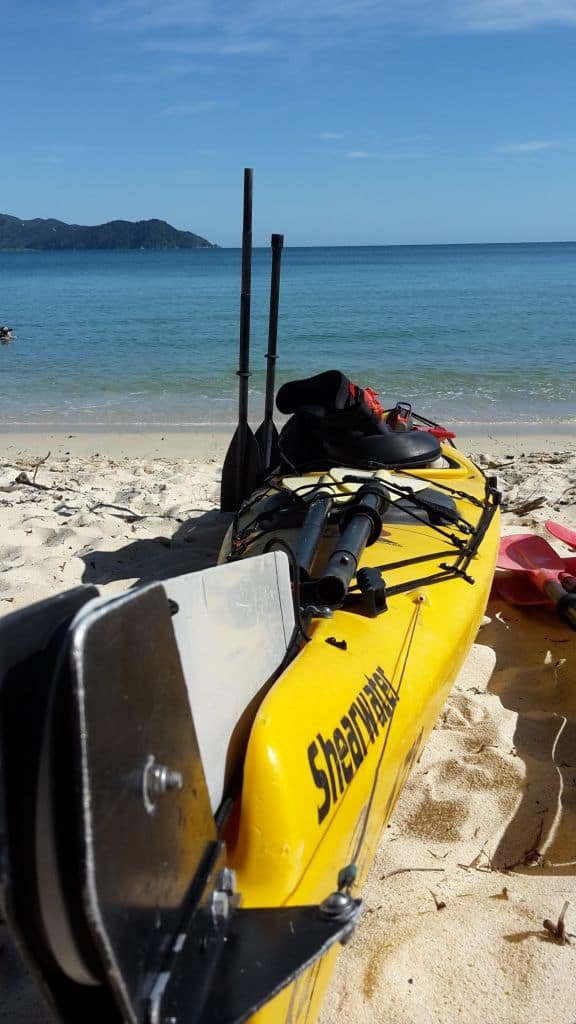
The wind was up the day we went and the crossing to Awaroa was rough, though it calmed as we came into the bay. Two hours in, at our lunch stop, we were both wrecked. We used to own our own kayaks and considered ourselves reasonably experienced, but a numb backside and a bad case of cramp told a different story. Over lunch we asked our guide if we could walk the second half instead of paddling it. She looked faintly surprised, made a call on the radio to sort out where our kayak would end up, and we spent the afternoon walking the coast track from Onetahuti to Bark Bay at our own pace instead.
Without realising it, we’d basically switched onto what Abel Tasman Kayaks now sell as The Two Gods, a kayak-and-walk combo (also around NZ$410pp) that pairs a paddle from Awaroa to Onetahuti with an unguided walk on to Bark Bay. If we were booking today, we’d book that one from the start rather than improvise it on the day.
Our honest tip: if you want to kayak, do the first half of your day on the water and save the second half for walking. Two hours of paddling is plenty for most people. You do see coves and inlets from a kayak that you’d never reach on foot, but walking the Onetahuti to Bark Bay section let us actually take the place in, rather than just survive it. You don’t pass many other people on that stretch, the signposted times are generous, and there are beaches along the way worth a swim if the weather’s playing along.
Split Apple Rock, if you have the time
Split Apple Rock wasn’t on our route (it sits closer to Kaiteriteri, north of Mārahau) but it’s one of the park’s best-known landmarks: a granite boulder split cleanly in two, sitting just offshore. Several operators, including Abel Tasman Kayaks’ Split Apple Classic, run shorter, gentler paddles out to it, and it’s a good option if you’re travelling with kids or nervous first-time kayakers rather than committing to a full day on the water.
Track and tide conditions to check before you go
The Abel Tasman Coast Track is a Great Walk and, as of July 2026, it’s fully open along its whole length, following repair work DOC completed in 2025 after storm damage between Mārahau and Anchorage. Bookings for huts and campsites are open for the 2026/27 season. This coastline does still get hit by slips after heavy rain, so check DOC’s Nelson/Tasman alerts before you set off, particularly outside the main summer season.
A few sections are tidal, most notably the Torrent Bay estuary and Awaroa Inlet, and you cannot cross them safely outside the tide windows DOC publishes. If your day trip touches either of those, check the current tide tables before you commit to a route.
Our top tips for a day trip
We were genuinely surprised at how good the DOC campsites are: proper toilets, a kitchen shelter, somewhere to have a campfire, and a front-row beach location most campgrounds would kill for. Campsite fees for 2026/27 run from around NZ$21 to NZ$31 per adult per night depending on season (children are cheaper, under-fives are free), and huts cost more. All huts and campsites must be booked online in advance now, all year round, so don’t turn up expecting to wing it.
We also learned that water taxis run far more often than you’d think, so unless you’re locked into a specific guided tour, you don’t always need to pre-book weeks ahead outside peak season. Our own parents simply turned up in Mārahau and jumped on the next available water taxi. In the busy months, though, book ahead. It’s easy to imagine that once the day-trippers clear out on the last water taxi, whoever’s still camping has a genuinely stunning stretch of coastline to themselves. We keep saying next time we’ll stay a couple of nights to find out.
One day was not really enough for us. If your schedule allows, give the Abel Tasman two days rather than one.
Where to stay near the park
If you want a day trip to be part of a longer South Island loop, our 10-day South Island self-drive itinerary shows how we built Abel Tasman into a wider trip with my parents, and our New Zealand itineraries hub has more route options if you’re still planning. If you’re travelling on a tighter budget, our guide to travelling New Zealand on a budget has practical ways to trim costs without cutting corners on the parts that matter.
Abel Tasman gets genuinely busy between September and March, so book accommodation well ahead if you’re visiting in that window. We’d suggest BookaBach for private homes you won’t always find on the big listing sites, or this accommodation search for motels, hotels and guesthouses in the area with live availability.
Your questions answered
How long do you need for a day trip to Abel Tasman National Park? A full day, realistically from around 8am to 4.30pm once you include the water taxi in and out. Most guided kayak-and-walk combos run to a similar schedule. If you can stretch it to two days, even one night camping in the park, most visitors say it’s worth it.
Do I need previous kayaking experience? No. Abel Tasman Kayaks’ guided trips take complete beginners, and the water inside the park is generally sheltered once you’re past the open crossings. If you’re not confident or not especially fit, plan for around two hours of paddling and swap the rest of the day for walking, as we did.
Is Split Apple Rock included on a standard Abel Tasman day trip? Not usually, since it sits further north near Kaiteriteri rather than on the main Mārahau-Awaroa-Bark Bay route. Several operators run dedicated shorter trips out to it, which suit families or first-time kayakers better than a full-day paddle.
Do I need to book a water taxi or kayak tour in advance? For a specific guided tour, yes, always. For an independent water taxi outside the busy summer season, you can sometimes turn up and catch the next available one, though booking ahead removes the risk entirely, especially between September and March when the park is at its busiest.
Can I camp in Abel Tasman National Park after a day trip? Yes, there are DOC campsites right along the coast track with toilets, kitchen shelters and beach access, and all of them must be booked online in advance for any date, all year round. Fees run roughly NZ$21 to NZ$31 per adult per night depending on the season, cheaper for children, free for under-fives.
Is the Abel Tasman Coast Track currently open? Yes, as of July 2026 the full track is open, with bookings running for the 2026/27 season. Slips do happen here after heavy rain, so it’s worth checking DOC’s current alerts shortly before you travel.
Got a question we haven’t covered, or spotted something that’s changed on the ground? Get in touch and we’ll look into it.
You might also like

Aoraki / Mount Cook Travel Guide
Our real Aoraki / Mount Cook guide: Hooker Valley Track status, Tasman Glacier, Dark Sky stargazing and where to stay. Updated August 2026.
A Weekend on the Coromandel Peninsula
Our updated 2026 guide to a weekend on the Coromandel Peninsula: Cathedral Cove's current access, Hot Water Beach timing, road status and where to stay.
The New Zealand bucket list: experiences that are actually worth it
Our honest New Zealand bucket list: 11 experiences from ten years living there, with genuine opinions on what's worth it and what to skip. Updated 2026.